

Productive, Creative or Sensitive
How representations make three qualities mutually exclusive

You may have met a wonderful artist who you wish would do something with their talent. You may have met a force-of-nature who misses no detail but struggles to think outside of the box, missing obvious options. You may have met someone who executes one plan after the other which work flawlessly if it were not for the people the alienate. Why can’t they fix the flaw even though it would serve them well? Because the nature of motivation excludes it. First the three terms will be defined, then representations in the mind will be modeled and finally former will be put in the latter to show this.
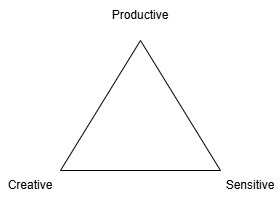
Definitions
Productivity is the ability to execute operations with consistency and to structure these for a long term reward autonomously. A productive person can and will execute specific steps in order and in time without direct reward per step but in the service of a later reward. The more consistent, the more materially specific and the further removed the reward can be, the more productive someone is.
Creativity is the ability to from examples and principles formulate possible steps to take or goals to achieve. A creative person sees more alternatives than a less creative person for the same problem. The more functioning alternatives can be generated, the more creative someone is.
Sensitivity is the feature that determines how much information someone takes in from the external world. A sensitive person notices more separate things from the same stimuli as others. The more objects and relations are added to thought from the same input, the more sensitive someone is.
Representations
Hume’s challenge to causality persists: there is no certain knowledge from patterns into the future, nor can a conclusion be noumenally founded even if the construct is matched. A football lying inside your living room amongst shattered glass and an appropriately sized hole in your window implies a chain of events, which is more likely than many alternatives; but not certain even if the most probable. Only present stimuli are in this sense ‘real’. The future is a projection, the past a revision. We must however still manage processes in the world that extend beyond the narrow present. In order to act and not just react we must have a representation of the future that is accurate enough. We then need to act with confidence in it. But what motivation would we have to pursue a particular projection. The present is always more probable than the future construct. You risk current reward for future reward proportionate to your ability to construct the future pathway both in skill and situation. There are limits to ability and many vantage points that make the functioning of the world opaque without a clear tell. We must get then some motivation to act on the representation. This motivation is a psychochemical reward to challenge present possible rewards: dopamine. A reward is placed to offset shorter term reward paths. But we have many thoughts, so which ones to embolden? The one that matches a past construct of a reward path. Whatever lead up to a last reward triggers a motivating feeling of anticipation. This reward often outpaces the reward. This helps orient one to the future and complex reasoned rewards. This leads to the sentiment that the pursuit of the thing is more gratifying than the thing itself. This is optimal, as this motivates you to achieve more. Contentedness does not change the world. One is paying off the impulses of the body for a bigger reward down the line. This is why when no progress is made, people degenerate to shorter term reward pathway. An analogy from Jonathan Haidt we can expand on is the elephant and the rider. In the analogy, he represents the interplay between emotions and reason as an elephant and its rider. The rider can steer and deny, but not propel forwards the elephant as its own motivation can. The elephant can comply, but as it receives to little reward or too much pain it will ignore the rider to satisfy its needs. To situate it more specifically; the body and its emotions will indulge the higher brain as long as it is on track. If stalled, the body cuts its losses. Another source of elephantine non compliance is stress or being overwhelmed. Stress is a negative emotion in the present of burden. The body can override the rider: you have gone beyond the risk parameters it is comfortable with and fears the loss of bodily integrity. Overwhelm is interesting in that it makes it impossible for the prefrontal cortex to accurately track the state of the project and the world separate from the self. Without proof of progress, the body reacts to get to a more manageable position to resume future planning or the nearest optimal value it can still project.
Combination
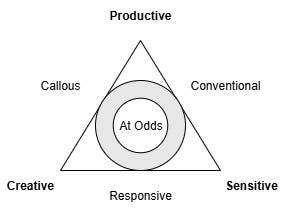
In this schema of reward and representation for action, the three qualities can be seen as descriptive of an underlying parameter. To act upon plans for future rewards means experiencing reward for anticipation more strongly. This is productivity. To have more possible plans to act on for more possible goals is creativity. Sensitivity is the more external data as objects, qualities and feelings that are taken in. The conflict arises that all three can interfere with one another as an outcome. As more data points are brought in, the more detail must be planned for. As more options get generated, the more choices there are. The more plans and details there are to consider, the less salient one option or a further option is. One must go to fulfill a more clear reward for a particular path to be acted on. Creativity also generates in its search for good plans a lot of bad ones. To risk is that anticipation gets pushed to a plan that appears optimally valuable but games the system. The people who work tirelessly and creatively often must sacrifice uncertain paths to compensate, preferring stable paths. This is great for symbolic processes like business, law, mathematics or engineering. Once the structure is in, local conditions don’t need to be consulted to check the plan. To not risk it, things with many outcomes and low rewards get culled: they dilute the reward for work calculation. This prevents the wilder parts of creativity of gumming up the works. The downside is that people are such a complicated low certainty thing: it is hard to force them or to know what there decisions will be to changing circumstances as opposed to a contract or machine. This is the low sensitivity model. Alternatively one can kick out creativity. We focus on the facts and pick from those. This often motivates toward existing models of functioning and convention. As there are less options generated, more options must be selected from the outside world as they are, the status quo. This helps the reward to be more focused. This is the low creativity model. If one has detail and alternatives, the reward gets ambiguous. This makes sense, as there are so many options and visions to mull over that feeling strongly for all would make action disjointed and erratic. The benefit is that observing relations becomes more likely, as intake does not have to filter for action. To observe things before they are useful and to consider many options and plan vaguely for them are qualities that make the observant artist. Art is possible detail and connection that could not be expressed productively yet is still enjoyable or motivating to others. These traits also aid someone’s sociability. They will notice things about people they can incorporate to understand them somewhere down the line. They are also flexible and generous with people, as they do not have maintain progress towards some end goal. They will have to enjoy someone in the present, which will likely turn to shared joy. To be observant, allowing and present are all qualities that aid social interaction. Someone that treats you script-like, steering you towards their goal and see no value until they get there rarely makes for great small talk. This is the low productivity model.
Dyads
These traits bite one another but also tether the person to external reality. Someone that is only productive has no conventional or new plans to act on and would act only on vague memories of past reinforcement with unlimited vigour. They will be callously use conventional schemas rigidly. Someone that is only creative has no need for the action or the world and so can think up the new without restriction and without use. They will be callously respond to situations without heed for what is conventional. Someone that is only sensitive is dominated by current sensations and has no need for the future or the alternative. They will respond conventionally to situations in a way that avoids complexity, action or conflict. These are limited strategies that lack flexibility. Dyads are thus the most common compromise that provide a mix of clarity and flexibility.
Conclusion
The nature of representation as a guiding tool in relation to the world as it appears makes mixing these three qualities difficult. One could suggest that modulation would be optimal, but the decision of what quality to increase or reduce would have to be pegged to the outcome in the future, which is known through the plans for the future already generated. To not fall for an at odds mixed model would mean to generate a cube of possibilities which itself would be more likely to make it less salient for action. The best ways to balance these needs is through others with different traits, tools that substitute the process or being in environments where the skill you lack are not called upon often.